
Written by Poonam Pankhania, Superintendent Pharmacist & Independent Prescriber
Medically reviewed by Poonam Pankhania, Superintendent Pharmacist & Independent Prescriber (GPhC 2068026) — last reviewed 23 November 2026
8 min read
The main symptoms of ear wax build up are muffled hearing, a blocked or full feeling in the ear, earache, ringing or buzzing (tinnitus) and sometimes dizziness. It usually affects one ear at a time. Olive oil drops often clear mild build-up within two weeks, but if your hearing is still blocked after five days, the wax may need removing.
Ear wax is not dirt. It is a natural mix of oils and skin cells that protects the ear canal and normally works its way out on its own. Problems start when it builds up faster than it clears, or gets pushed deeper. This guide explains how to recognise a wax blockage, how to tell it apart from an ear infection or the blocked ears that come with a cold, what you can safely do at home, and when it is worth booking a check at our pharmacy on Pinner Road.
Symptoms of ear wax build up
The NHS page on earwax build-up lists four main symptoms:
- Hearing loss. Sounds seem quieter or muffled, as if you are wearing an earplug. People often notice it first on the phone or when the television needs turning up.
- Earache or a blocked, full feeling. Many people describe it as pressure, or as water stuck in the ear that will not shift.
- Ringing or buzzing (tinnitus). A plug of wax resting against the eardrum can make you more aware of your own internal sounds.
- Vertigo. A spinning or off-balance feeling, which is less common but does happen.
Other clues point towards wax rather than something else. Symptoms that come on gradually, or suddenly after a shower or swim when water makes the wax swell, are typical. So is a blocked ear soon after using cotton buds, or a hearing aid that starts whistling more than usual. Itchiness in the ear canal can be part of it too.
Why some people get more ear wax than others
Everyone makes ear wax, and in most people the ear canal cleans itself. Jaw movements from talking and chewing slowly carry old wax and skin outwards, where it dries and falls away without you noticing. A blockage happens when something interrupts that conveyor belt.
Build-up is more likely if you have narrow, curved or hairy ear canals, if you wear hearing aids, earplugs or in-ear headphones for long periods, or if you regularly use cotton buds, which push wax back towards the eardrum. Wax also tends to become drier and harder with age, which is why older adults are more often affected. Some people simply produce more wax than others, and it can run in families. None of this means your ears are unclean, and washing them more will not stop it happening.
If you have had a blockage before, it is likely to come back at some point. Using a couple of drops of olive oil in each ear once a week or so can help keep wax soft, but it is worth asking a pharmacist first if you have had ear problems or surgery in the past.
Ear wax in children and hearing aid users
Children make ear wax too, but blockages are less common and earache in a child is more often caused by an infection after a cold. If your child is pulling at an ear, has a temperature or seems unwell, treat it as possible earache rather than wax, and never use cotton buds to clean a child's ears. A pharmacist or GP can look in the ear and advise.
Hearing aid users are among the people we see most often. A hearing aid sits in the ear canal for hours a day, which stops wax moving out naturally. Signs include the aid whistling more than usual, sound seeming weaker even with new batteries, or wax collecting on the tip or dome. If your hearing aid suddenly seems less effective, it is worth having your ears checked before assuming the aid needs adjusting.
Is it ear wax, an ear infection or a cold?
A blocked ear in winter is not always wax. The table below shows the usual differences, though only an examination of the ear canal can confirm what is going on.
| Cause | Typical signs | Usually helps |
|---|---|---|
| Ear wax build-up | Muffled hearing and a full feeling, usually in one ear, often coming on gradually or after water gets in. Little or no pain, no fever. | Olive or almond oil drops for 3 to 5 days, then removal if still blocked |
| Blocked ear after a cold | Both ears may feel blocked or pop, alongside a runny or blocked nose. Often improves as the cold clears. | Time, and treating the cold. Gentle swallowing or yawning can help the ears pop |
| Middle ear infection | Earache that can be sharp, a high temperature, feeling unwell. Common in children, often after a cold. | Most settle within 3 days. Children aged 1 to 17 can be assessed through Pharmacy First |
| Outer ear infection (swimmer's ear) | Pain that is worse when you touch or pull the ear, itching, redness and sometimes discharge. | Pharmacist or GP advice. Ear drops may be needed |
If the ear is painful rather than just blocked, or you have a temperature, it is more likely to be an infection than wax. For children with earache, our guide to what Pharmacy First covers explains how a pharmacist can assess earache without a GP appointment.
What you can do at home
For mild symptoms, the NHS recommends trying oil drops first. This softens the wax so the ear's natural self-cleaning can move it out:
- Lie on your side with the affected ear facing up.
- Put 2 to 3 drops of olive or almond oil into the ear.
- Stay lying on your side for 5 to 10 minutes so the oil can soak in.
- Repeat 3 to 4 times a day, for 3 to 5 days.
The NHS says lumps of wax should fall out over about two weeks, often at night, so you may not notice them go. Your hearing can feel slightly worse for a day or two at first as the wax softens and swells, which is normal. Pharmacy wax-softening drops are an alternative if you prefer them, and we can help you choose one.
Do not use drops if your eardrum may be perforated
Do not put oil or drops in your ear if you have, or think you may have, a hole in your eardrum, if you have grommets, or if there is discharge coming from the ear. Ask a pharmacist or GP first.
What to avoid
The NHS advice is clear: do not use your fingers or cotton buds to clear ear wax. They push the wax further in and make the blockage worse, and they can scratch the delicate skin of the ear canal. Hair grips, keys and other objects carry the same risk, plus the chance of damaging the eardrum.
The NHS also notes there is no evidence that ear candles or ear vacuums remove wax. Candling can cause burns and leave candle wax in the ear. If drops have not worked, the next step is a proper look inside the ear and removal by a trained clinician.
When ear wax needs removing
The NHS advises getting help if your symptoms have not cleared after 5 days of drops, or if your ear is so blocked that you cannot hear anything. Left in place, a plug of wax can occasionally lead to an infection.
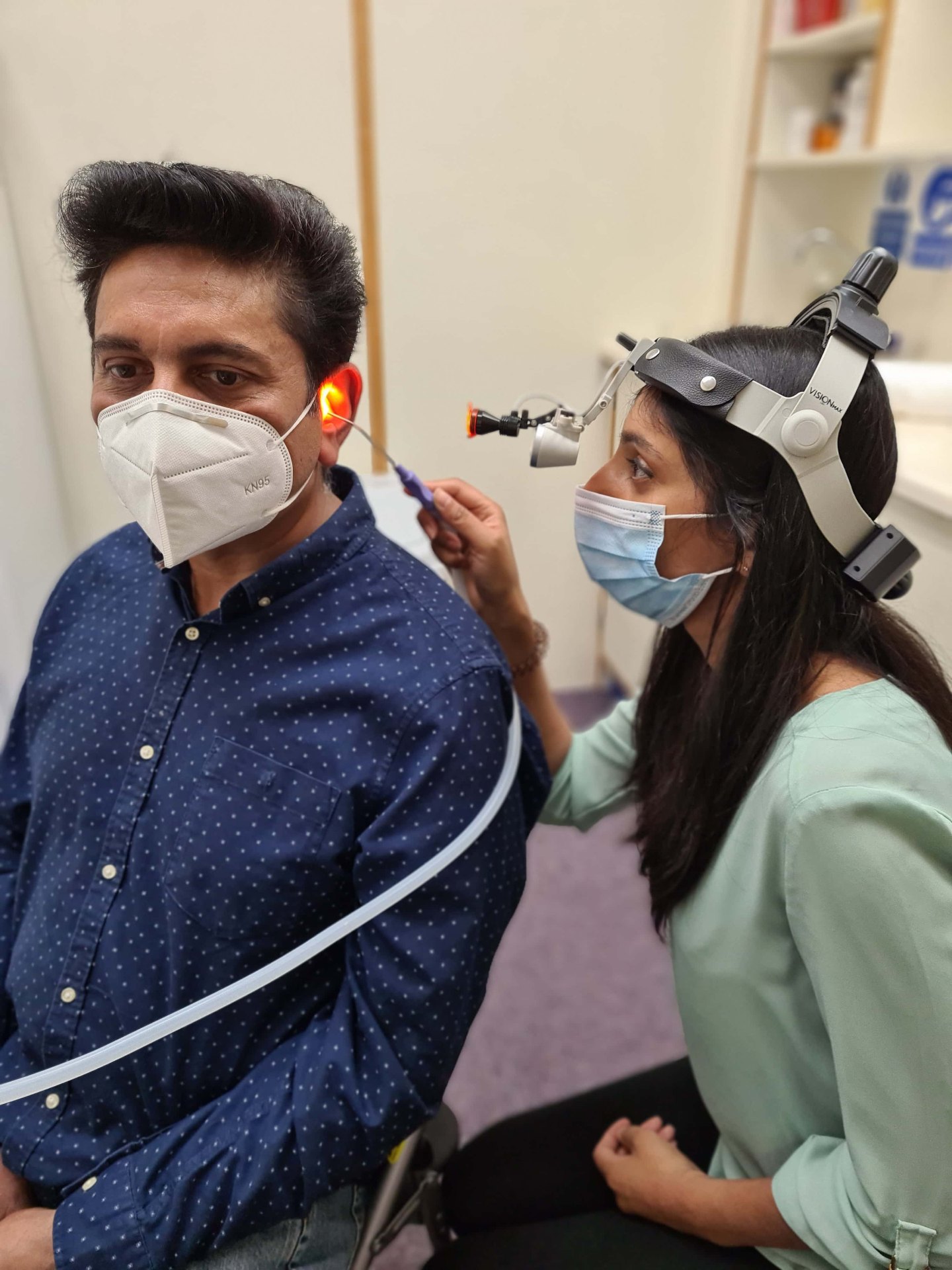
Not all GP surgeries remove ear wax, and many people in Harrow and Pinner are now told it is not available at their practice. Where it is not offered, the usual options are a referral or a private appointment at a pharmacy or hearing centre. The two main professional methods are microsuction, where wax is lifted out with gentle suction while the clinician looks into the ear, and electronic irrigation, which uses warm water. Our guide to ear wax removal methods compares them in detail, including who each one suits.
At a removal appointment, the clinician first asks about your symptoms and ear history, then examines both ears with a light. If wax is the problem, microsuction usually takes around 15 to 30 minutes for both ears. Most people find it comfortable, with some noise from the suction and occasionally a brief dizzy feeling or a tickle. Hearing often improves straight away, and sounds can seem unusually loud or sharp for the rest of the day. If the wax is very hard, you may be asked to use olive oil for a few more days and come back, rather than forcing it out in one go.
Wax removal is not right for everyone straight away. If you have ear pain, discharge, a recent ear infection or have had ear surgery, tell us when you book, as you may need to see your GP first.
When to see a GP instead
Some symptoms that feel like wax need medical advice rather than removal. Contact your GP or NHS 111 if you have:
- Sudden hearing loss in one or both ears, especially without any obvious blockage
- Severe ear pain, a high temperature, or swelling or redness behind the ear
- Discharge, blood or fluid coming from the ear
- Something stuck in the ear
- Dizziness that does not go away, or a feeling that the room is spinning with sickness
Sudden hearing loss in particular should be checked quickly, ideally the same day, because some causes respond best to early treatment. If you are unsure, our pharmacists can advise you on where to go.
Ear wax checks and removal in Harrow
At Garner Chemist, 160 Pinner Road, our clinician always looks inside the ear first to check that wax really is the cause before anything is removed. If it is, we can remove it with microsuction in our private consultation room, usually in a single appointment for both ears. We are on Pinner Road between North Harrow and Harrow town centre, around 10 minutes from Rayners Lane and a straightforward journey down Pinner Road from Pinner.
If you have hearing aids, bring them along, and if you have already been using olive oil, keep going until your appointment, as softened wax is quicker and more comfortable to remove. Prices can change, so please contact us for current pricing. You can find full details on our ear wax removal service page.
This guide was checked against the NHS earwax build-up page in November 2026. It is general information and does not replace an examination of your ears.
Frequently asked questions
Where our patients travel from
We are at 160 Pinner Road, Harrow HA1 4JJ. Patients come to us for symptoms of ear wax build up from across north-west London and the surrounding HA postcodes:
- North Harrow (HA1, HA2) — on Pinner Road between North Harrow and Harrow town centre. Near North Harrow station and Pinner Road.
- Rayners Lane (HA2, HA5) — around 10 minutes from Rayners Lane. Near Rayners Lane station and Alexandra Avenue.
- Pinner (HA5) — straight down Pinner Road from Pinner, roughly a 10-minute drive. Near Pinner station and Pinner High Street.
About the author
Poonam Pankhania — Superintendent Pharmacist & Independent Prescriber
Poonam Pankhania is the Superintendent Pharmacist at Garner Chemist on Pinner Road, Harrow, and an independent prescriber. She leads the pharmacy's NHS Pharmacy First, travel health and ear care services.
More about our teamRelated health advice
Ear Wax Removal Methods Compared: Microsuction vs Irrigation vs Drops
Microsuction, irrigation or drops? A pharmacist compares every ear wax removal method on safety, speed, comfort and cost.

What Is Pharmacy First? The 7 Conditions Your Pharmacist Can Treat Without Seeing a GP
Pharmacy First lets your pharmacist assess and treat seven common conditions on the NHS — no GP appointment, no referral, often same day.