
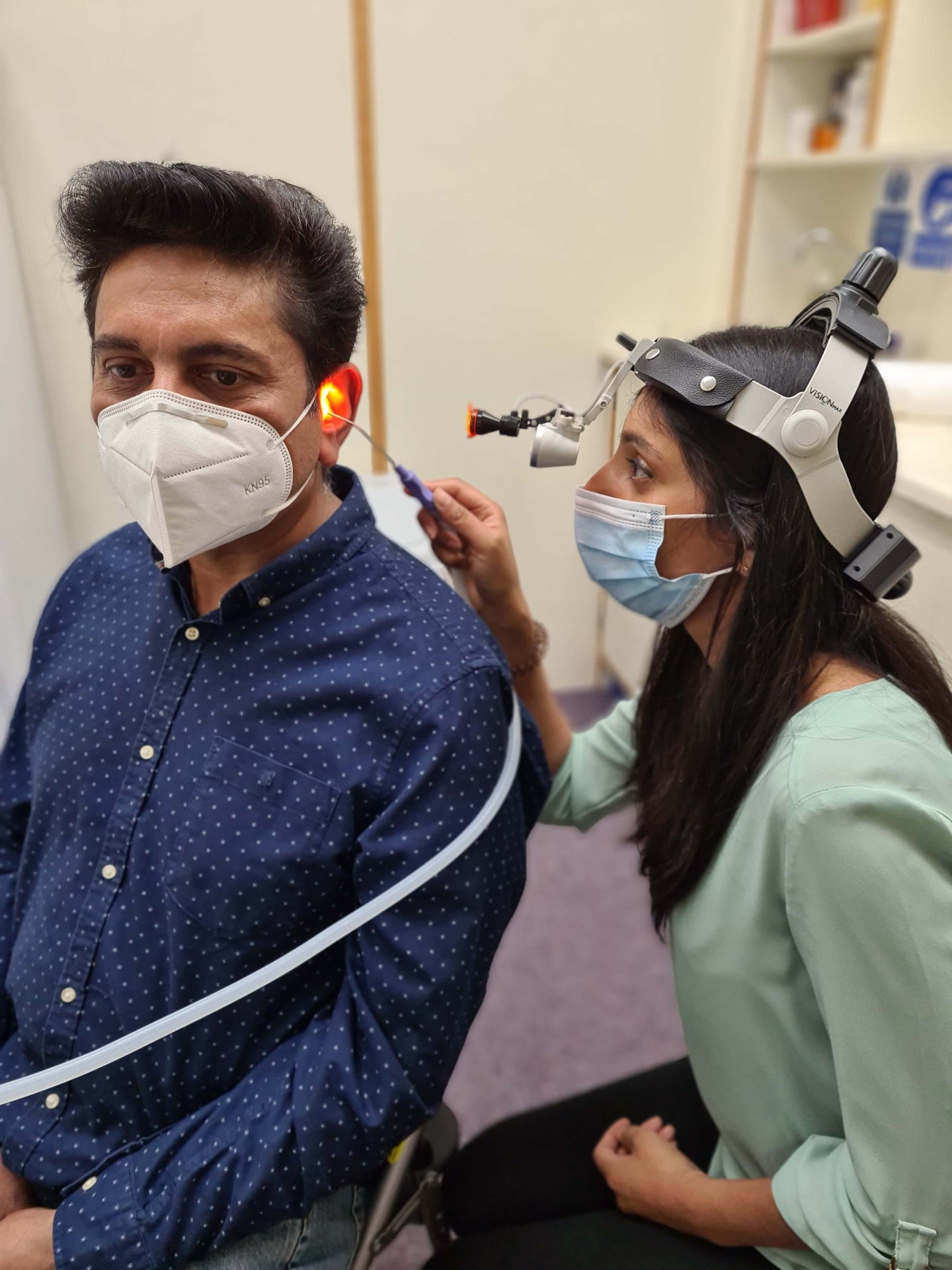
Written by Poonam Pankhania, Superintendent Pharmacist & Independent Prescriber
Medically reviewed by Poonam Pankhania, Superintendent Pharmacist & Independent Prescriber (GPhC 2068026) — last reviewed 28 July 2026
9 min read
The main ear wax removal methods are microsuction, ear irrigation, manual removal with fine instruments, and softening drops used on their own. Microsuction is the safest choice for most people, because it uses gentle suction under direct vision and puts no water into the ear canal. Which method suits you depends on your ear history and the type of wax.
Ear wax removal methods at a glance
| Method | How it works | Typical time | Best suited to |
|---|---|---|---|
| Microsuction | A clinician looks into the ear with a microscope or magnifying loupes and lifts the wax out with a fine, low-pressure suction tube. No water goes into the ear. | About 15 to 30 minutes for both ears | Most people, and usually the method chosen where irrigation is unsafe — after a perforated eardrum, grommets or ear surgery — or for very hard impacted wax. The ear is examined first. |
| Irrigation (syringing) | An electronic irrigator pumps warm water into the ear canal at a controlled pressure to float the wax out. This is not the old-style hand syringe. | About 15 to 30 minutes for both ears | Healthy ears with an intact eardrum, no ear surgery, no grommets and no recent infection or discharge |
| Manual removal with instruments | A clinician removes the wax under direct vision using fine tools such as a wax hook, loop or probe. It is often combined with microsuction. | A few minutes per ear, usually within a longer appointment | Soft or loosely attached wax sitting near the entrance of the ear canal, or a lump of wax that suction alone will not shift |
| Softening drops alone | Olive oil or a pharmacy wax-softening product breaks the wax down so the ear's own self-cleaning action can carry it out. | A few minutes a day at home, over one to two weeks | Mild build-up without significant hearing loss, and as preparation in the days before any procedure |
If you are searching for ear wax removal in Harrow, the practical choice usually comes down to microsuction or irrigation, because drops on their own rarely clear wax that has already become firmly impacted. We offer microsuction at our Pinner Road pharmacy, and our clinician will always check your ears with an otoscope first to confirm that wax really is the problem before anything is removed.
Why ear wax builds up in the first place
Ear wax, or cerumen, is not dirt. Glands in the outer part of the ear canal produce it constantly to trap dust, keep the skin supple and protect the canal from water and bacteria. A healthy ear is self-cleaning: jaw movement from talking and chewing slowly carries old wax outwards, where it dries and falls away without you noticing.
That system stops working smoothly for some very ordinary reasons. Hearing aids, in-ear headphones and earplugs sit in the canal and block the outward path. Some people simply have narrow or unusually hairy ear canals. Wax becomes drier and harder as we get older, so it travels less easily. Skin conditions such as eczema or psoriasis increase the amount of debris in the canal. And cotton buds, which many people reach for first, push most of the wax deeper rather than removing it.
Once wax fully blocks the canal, the symptoms are hard to ignore. Hearing goes muffled or drops away on one side. The ear feels full or under pressure. Some people get ringing or buzzing, mild dizziness, itching, or a nagging cough set off by pressure on the canal. Earache is common too, although pain has other causes, so it is worth reading about the difference between blocked ears and infection on our NHS Pharmacy First earache service page. If the ear is painful, discharging or hot, that needs assessing before any wax is removed.
Microsuction: the safest option for most people
Microsuction is now the method most ear care clinicians reach for first. Your clinician wears magnifying loupes or uses a microscope so the ear canal and eardrum stay in clear view throughout, then uses a thin metal suction tube, a little like a miniature vacuum, to draw the wax out piece by piece. Nothing is flushed in, nothing is done blind, and the clinician can stop the moment anything looks unexpected.
That direct vision is exactly why microsuction is suitable for ears that rule out other methods. It is usually the preferred approach for people with a perforated eardrum, past or present, because no water or pressure is pushed towards the hole — though the ear is always examined first to confirm removal is appropriate. It also suits people with grommets, mastoid cavities, previous ear surgery, or a single hearing ear, where irrigation would carry real risk. The one group who should check first are people who have had ear surgery other than grommets within roughly the last two years and are no longer under ENT follow-up. Tell us about any operation when you book and we will confirm whether to proceed or refer you back.
Be prepared for the noise. Suction close to the eardrum is genuinely loud, often described as a roaring or crackling sound, and it can feel odd for a moment. Most people find it uncomfortable rather than painful. Brief dizziness is possible if the wax is cold or sits against the eardrum, and it settles quickly. Rarely, the canal skin can be grazed, or tinnitus can be temporarily more noticeable. These risks are small, but they are real, and they are smaller still when the wax has been softened for a few days beforehand.
Microsuction is a private service rather than an NHS one at most pharmacies. Please call us on 020 8863 6338 for current pricing and to check that microsuction is right for your ears; full details are on our ear wax removal service page.
Ear irrigation (sometimes called syringing)
Irrigation uses a machine that delivers a controlled jet of warm water into the ear canal, aimed along the canal wall rather than at the eardrum, so the water gets behind the wax and floats it out. It is important to separate this from the old-style manual metal syringe. National guidance for the NHS is clear that manual syringing should no longer be used, because the pressure could not be controlled and injuries were more common. Modern electronic irrigation is a much gentler procedure.
Even so, irrigation has a long list of situations where it should not be used at all. Water in the wrong ear can cause infection or lasting damage, so it is normally avoided if you have or have ever had a perforated eardrum, if you have grommets or a T-tube in place, or if you have had middle ear surgery such as a myringoplasty, stapedotomy or mastoid operation. It is also avoided after any discharge from the ear in the past year, after a middle ear infection in the past six weeks, with a repaired or unrepaired cleft palate, with a cholesteatoma or retraction pocket, and where someone only has hearing in one ear.
That list covers a lot of people, which is one reason microsuction has become the default. Irrigation still works well for straightforward, well-softened wax in a healthy ear, and some patients find it more comfortable because it is far quieter. The honest summary is that irrigation is a good method for the right ear, and the wrong method for any ear with a history.
Softening drops: olive oil and pharmacy products
Drops are the gentlest of the ear wax removal methods and the only one you can safely do yourself. The NHS advises putting 2 to 3 drops of plain olive oil or almond oil into the affected ear, 3 to 4 times a day, for 3 to 5 days. Avoid almond oil if you have a nut allergy. Warm the bottle briefly in your hand first, lie on your side with the treated ear facing up, and stay there for 5 to 10 minutes so the oil runs down the canal instead of straight back out. Wax often clears on its own within about two weeks.
Pharmacy wax-softening drops and sprays containing sodium bicarbonate or urea hydrogen peroxide work in a similar way and typically take around a week. Come and speak to us if you are not sure which to choose. What drops cannot do is help quickly: your hearing may briefly get worse before it gets better as the softened wax swells. If nothing has shifted after five days, or your hearing is badly affected, it is time to have the wax removed properly rather than persist. You can read the full self-care advice in the NHS guidance on earwax build-up.
One caution: do not put drops into an ear that is painful, discharging, or known to have a perforated eardrum or grommets, unless a clinician has told you to. Ask us first and we will look in the ear before recommending anything.
Methods to avoid: cotton buds, ear candles and DIY kits
Please do not use these on your ears
Cotton buds. A bud is wider than the wax it is meant to catch, so it removes a little from the entrance and pushes the rest deeper, where the canal is narrower and the skin is thin. This is one of the most common causes of the impacted wax we see. Buds also scratch the canal, which can trigger infection, and can perforate the eardrum if someone knocks your arm.
Ear candling. There is no evidence that ear candles or ear vacuums remove wax, and the residue left in the cone is candle wax, not ear wax. Published case series record burns to the ear and face, candle wax setting hard inside the ear canal and on the eardrum, perforated eardrums, temporary hearing loss and outer ear infections. It is a treatment with no benefit and a genuine chance of harm.
Also avoid hairpins, keys, cotton wool twists and pressurised home irrigation bulbs. If you cannot see into the ear, you cannot remove wax safely.
Preparing for your appointment
A little preparation makes a real difference to how comfortable and how successful the appointment is. Use olive oil drops or a wax-softening spray for three to five days beforehand, including on the morning of your visit. Softened wax lifts out in minutes; rock-hard wax that has been dry for months can take much longer and is more uncomfortable to remove.
Bring your softening spray with you, and be ready to tell us about your ear history: any operations, grommets, perforations, recent infections, discharge, dizziness, tinnitus, or whether you rely on hearing in one ear only. Mention any blood-thinning medication too. Your clinician will examine both ears with an otoscope before touching anything, explain what they can see, and check your consent before starting. If wax is not the cause of your symptoms, we will tell you that and point you to the right service instead.
When ear wax removal is not suitable
Not every blocked-feeling ear is a wax problem, and part of our job is knowing when to stop and send you elsewhere. We will not remove wax, and will refer you on, if there is active pain, discharge, bleeding or a fever suggesting infection, or if the ear canal is very swollen. Sudden hearing loss that came on over hours or a few days, with no visible wax, is treated as urgent and needs same-day medical assessment, not a wax appointment.
We will also pause and check before proceeding if you have had ear surgery other than grommets in the last couple of years, if you are currently under ENT care, if you have persistent vertigo, or if a child needs wax or a foreign object removed, which is usually best done in a specialist setting. If your main symptom is earache rather than blocked hearing, our earache consultation may be the better starting point, and it is free on the NHS for eligible patients.
Wax removal is rarely available on the NHS locally
National guidance says ear wax removal should be available in primary or community care, but commissioning has not kept up. Research by the charity RNID found that North West London, the area covering Harrow, was one of only six integrated care boards in England commissioning no ear wax removal service at all. Provision does change, so it is always worth asking your own GP practice first, but in practice most patients here need to arrange it privately.
Ear wax removal in Harrow, Pinner and Ruislip
We see the effect of that gap every week at our Pinner Road pharmacy in North Harrow. Patients come to us for microsuction in Harrow after being told their surgery no longer offers wax removal, and many travel a short way to reach us: people looking for ear wax removal in Pinner find us a few minutes down the road, and those searching for ear wax removal in Ruislip often choose us because there is no NHS alternative on their own doorstep either. Hearing aid users in particular tend to come back every few months, because moulds and domes hold wax in the canal.
You will find us at 160 Pinner Road, Harrow HA1 4JJ, close to North Harrow station and on local bus routes, with parking nearby. We are open Monday to Friday from 9am to 6pm and Saturday from 9am to 1pm. Appointments are recommended so that a clinician is free to give your ears proper time, although we will always try to help if you call in.
To check whether microsuction is suitable for you, or to ask about current pricing, call us on 020 8863 6338 or read more on our ear wax removal page. If you are unsure whether your symptoms are wax at all, tell us what you are experiencing when you ring and we will advise honestly, including telling you when you do not need a procedure.
Frequently asked questions
Where our patients travel from
We are at 160 Pinner Road, Harrow HA1 4JJ. Patients come to us for ear wax removal methods from across north-west London and the surrounding HA postcodes:
- North Harrow (HA1, HA2) — on Pinner Road between North Harrow and Harrow town centre. Near North Harrow station and Pinner Road.
- Pinner (HA5) — straight down Pinner Road from Pinner, roughly a 10-minute drive. Near Pinner station and Pinner High Street.
- Ruislip (HA4) — roughly 15 minutes from Ruislip along the A404. Near Ruislip station and Ruislip Manor.
- Northwood (HA6) — about 15 minutes from Northwood. Near Northwood station and Northwood Hills.
About the author
Poonam Pankhania — Superintendent Pharmacist & Independent Prescriber
Poonam Pankhania is the Superintendent Pharmacist at Garner Chemist on Pinner Road, Harrow, and an independent prescriber. She leads the pharmacy's NHS Pharmacy First, travel health and ear care services.
More about our teamRelated health advice
What Is Pharmacy First? The 7 Conditions Your Pharmacist Can Treat Without Seeing a GP
Pharmacy First lets your pharmacist assess and treat seven common conditions on the NHS — no GP appointment, no referral, often same day.