
Written by Poonam Pankhania, Superintendent Pharmacist & Independent Prescriber
Medically reviewed by Poonam Pankhania, Superintendent Pharmacist & Independent Prescriber (GPhC 2068026) — last reviewed 7 October 2026
9 min read
What do blood pressure numbers mean? The top number is the pressure as your heart pushes blood out; the bottom number is the pressure as it relaxes between beats. Ideal is between 90/60 and 120/80. High is 140/90 or above when a professional measures it, but 135/85 or above when measured at home.
The two numbers in a blood pressure reading
A reading is always written as one number over another, such as 128/82, and said aloud as "128 over 82". Both are measured in millimetres of mercury, written mmHg, a unit left over from the days when blood pressure was read off a glass column of mercury rather than a digital screen.
The top number is systolic pressure: the highest point your blood pressure reaches as your heart contracts and pushes blood out into your arteries. The bottom number is diastolic pressure: the lowest point it falls to while your heart relaxes and refills between beats. One reading is a snapshot of the squeeze and the pause.
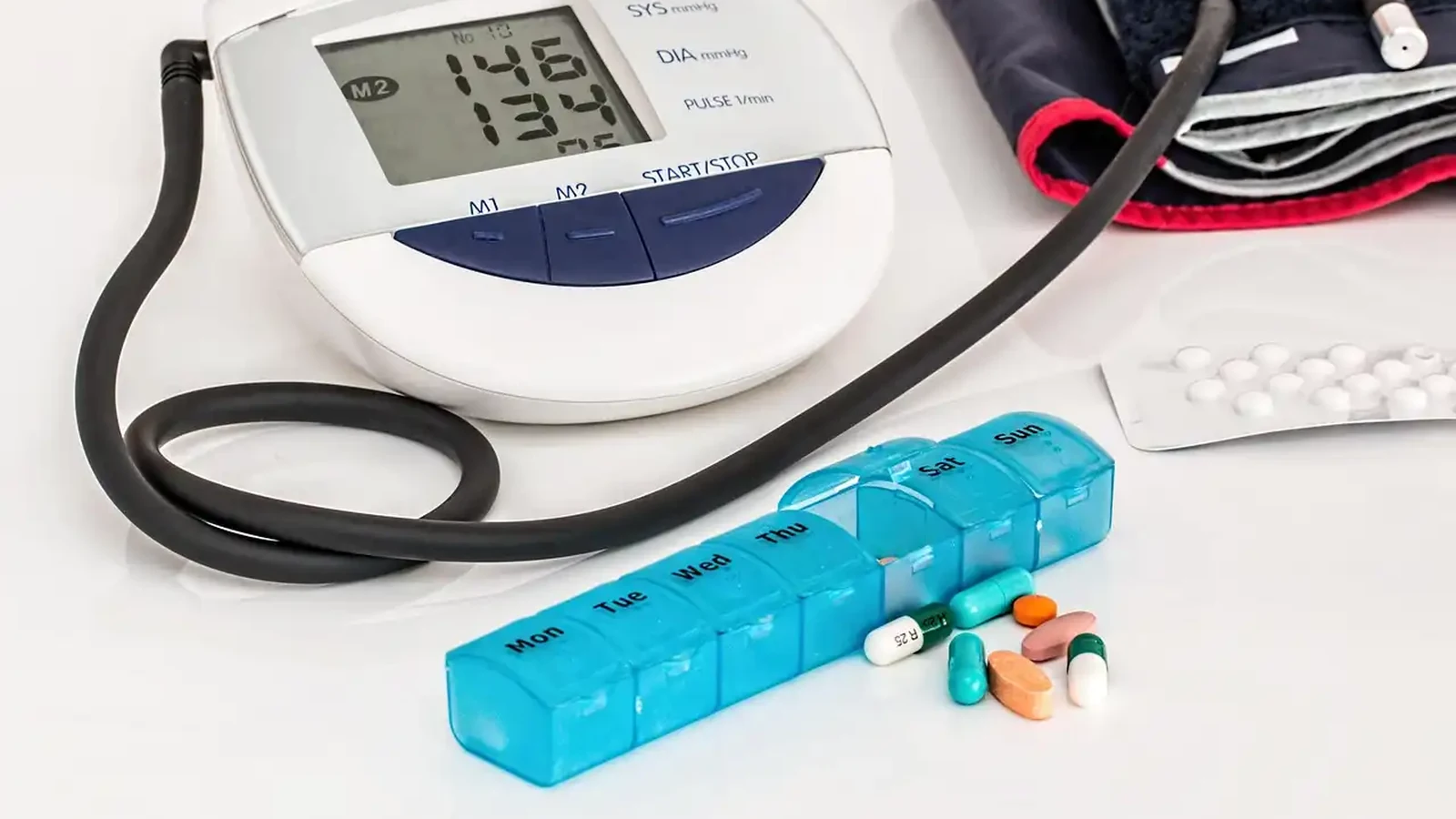
Most home monitors show a third number, usually labelled PULSE or with a small heart symbol. That is your heart rate in beats per minute, not part of your blood pressure, and it does not go into the fraction. People regularly copy all three into a notebook and then worry that the last one looks too low to be a blood pressure. It is not meant to be one.
Blood pressure is not fixed. It rises when you walk up a hill, talk, laugh, feel anxious or need the toilet, and falls when you sleep. A single number is therefore never the whole story, and nobody is diagnosed with high blood pressure from one reading. What matters is the pattern, which is why the next section gives two sets of thresholds rather than one.
Normal blood pressure range, and the bands above it
The normal blood pressure range for an adult is generally described as between 90/60mmHg and 120/80mmHg. Blood Pressure UK calls this ideal blood pressure, and at that level your risk of heart disease and stroke is much lower than above it.
Between 120/80 and 140/90 is sometimes called pre-high or high-normal. It is not high blood pressure and it is not treated with medicine on that basis, but it is a signal: readings in this band tend to creep upwards with the years, and it is the point at which changes to salt, alcohol, weight and activity do the most good for the least effort.
Above that, UK doctors follow the stages set out by NICE in its hypertension guideline. The important detail is that every stage has two thresholds, one for a reading taken by a health professional and a lower one for an average of readings taken at home or on a 24-hour monitor.
| Band | Measured by a health professional | Average at home or on 24-hour monitoring | What it usually means |
|---|---|---|---|
| Low | Below 90/60 | Below 90/60 | Often harmless and common in fit people. Only a concern if it causes dizziness or fainting. |
| Ideal | 90/60 up to 120/80 | No finer home bands are published; below 135/85 is not high | Healthy. Recheck at least every five years once you are 40 or over. |
| Pre-high (high-normal) | 120/80 up to 140/90 | No finer home bands are published; below 135/85 is not high | Not high blood pressure, but worth acting on with lifestyle changes before it rises further. |
| Stage 1 high blood pressure | 140/90 to 159/99 | 135/85 to 149/94 | High. Confirmed with home or 24-hour monitoring, then discussed with your GP. |
| Stage 2 high blood pressure | 160/100 up to 180/120 | 150/95 or higher | High. Your GP will usually recommend treatment alongside lifestyle changes. |
| Severe high blood pressure | Top number 180 or more, or bottom number 120 or more | Do not wait for an average | Needs a GP the same day. Call 999 if it comes with chest pain, sudden severe headache, blurred vision, breathlessness or weakness down one side. |
Read the table by whichever number is worse. A reading of 132/94 is in stage 1 even though the top number on its own looks ideal, because the bottom number has crossed 90. The same is true the other way round: 150/78 is high, whatever the diastolic says. You do not need both numbers over the line.
Which number matters more?
Both count, but they tend to tell different stories at different ages. In younger adults a raised bottom number is common, and in people over about 50 it is far more often the top number that climbs while the bottom one stays put or even falls. That is because arteries stiffen with age, so each beat produces a sharper peak. A high top number with a normal bottom number is still high blood pressure, and it is not something to dismiss as "just age".
The gap between the two numbers is sometimes printed by monitors as pulse pressure. It is interesting to clinicians, but it is not a figure you need to track or act on yourself. Stick with the two numbers and the bands above.
Why home readings have a lower threshold
This is the part of what blood pressure numbers mean that confuses people most. Why should 135/85 count as high at home when 140/90 is the line in a surgery or pharmacy?
Because the same person usually reads a little lower at home. A clinic visit involves travelling, waiting, a stranger and a cuff, and all of that nudges blood pressure up. In some people the effect is large enough to make a normal blood pressure look high, which is known as white coat hypertension. Others have the opposite: a normal reading in the consulting room and raised blood pressure the rest of the day, sometimes called masked hypertension. Readings taken in everyday life cut through both, which is why NICE uses them to confirm a diagnosis and sets their thresholds slightly lower to match.
If you are measuring at home, a few habits make the numbers worth having:
- Use an upper-arm cuff that fits. Wrist monitors are more sensitive to position, and a cuff that is too small for your arm reads high.
- Sit quietly for five minutes first, back supported, feet flat on the floor, arm resting on a table at roughly heart height. No talking during the reading.
- Avoid caffeine, smoking and exercise for half an hour beforehand, and empty your bladder first.
- Take two readings a minute apart, morning and evening, as the NHS blood pressure test guidance describes. When the aim is a diagnosis, NICE advises carrying on for at least four days and ideally seven, ignoring the first day, and averaging the rest.
- Write them all down, including the ones you would rather not. An average built only from the good days is no use to anyone.
If you are not sure your monitor is accurate, bring it in. We can take a reading on ours and on yours a few minutes apart and see whether they agree.
High blood pressure symptoms: usually none at all
The most important thing to know about high blood pressure symptoms is that there usually are not any. The NHS is blunt about it: many people have high blood pressure without realising. You can feel entirely well with a reading of 160/100, and many people do, for years.
That is exactly what makes it dangerous. Untreated, high blood pressure raises the risk of heart attack, stroke, heart failure, kidney disease and vascular dementia, and it does that damage quietly. Waiting for symptoms is waiting too long. Rarely, very high blood pressure can cause headaches, blurred vision or chest pain, and those deserve attention straight away.
When a reading needs urgent action
A top number of 180 or more, or a bottom number of 120 or more, is severe. Sit quietly for five minutes and measure again. If it is still that high, contact your GP surgery the same day, or NHS 111 if they are closed. If we find a reading like that in the pharmacy, we refer you urgently to be seen by your GP within 24 hours and contact the surgery ourselves.
Call 999 instead if a high reading comes with chest pain, a sudden severe headache, blurred vision, breathlessness, confusion, or weakness or numbness down one side of the body. Do not drive yourself anywhere and do not come to the pharmacy.
What about low blood pressure?
The NHS defines low blood pressure as a reading below 90/60. For many people, particularly fit and younger adults, that is simply how their body runs, and it needs no treatment. It matters only when it causes symptoms: light-headedness or dizziness, especially on standing up quickly, feeling sick, blurred vision, weakness, confusion or fainting.
If that keeps happening, see your GP. If you take a blood pressure medicine and have started feeling dizzy, mention it to us too. It can be a sign the dose is now more than you need, which is worth knowing, but do not stop the medicine on your own.
Your target if you are already being treated
Once you are on treatment, the question changes from "is this high?" to "is this on target?". NICE sets the usual targets by age:
- Under 80: below 140/90 when measured in a clinic or pharmacy, and below 135/85 at home.
- 80 and over: below 150/90 when measured in a clinic or pharmacy, and below 145/85 at home.
Your own target may be different. Other conditions, frailty, or problems with dizziness on standing can all lead your GP to set a figure that suits you better, and the number on your own plan is the one that counts.
If your readings stay above target, the reason is often not that the medicine has stopped working. It is frequently missed doses, side effects that make people quietly stop, or several medicines that are hard to keep straight. A medication review is a good place to untangle that, and if you have just been prescribed a blood pressure medicine for the first time, our guide to starting a new medicine explains the free NHS follow-up you can have with a pharmacist over your first few weeks. Weight is closely linked to blood pressure as well, and our post on pharmacy weight management covers the support available.
Getting your numbers checked in Harrow
If you are 40 or over and have not had your blood pressure checked in the last five years, you can have it done free on the NHS at our pharmacy at 160 Pinner Road, with no appointment and no GP referral. Our pharmacist can also use their discretion for people aged 35 to 39, and for under-40s with a family history of high blood pressure. It takes about five minutes in a private room, and you leave knowing your numbers and what they mean.
If the reading is raised, we can fit a 24-hour monitor so you get the everyday picture described above rather than a single snapshot, and we send the results to your GP. Our NHS blood pressure check service page explains each step. Plenty of people call in on Pinner Road on their way between North Harrow and the town centre, and others come down from Harrow Weald or over from Pinner, often having put it off for years because they felt fine. That is the point: feeling fine tells you nothing about blood pressure.
We are open Monday to Friday 9am to 6pm and Saturday 9am to 1pm, and closed on Sunday. You can ring us on 020 8863 6338 or use the contact page if you have a question about your readings first.
Frequently asked questions
Where our patients travel from
We are at 160 Pinner Road, Harrow HA1 4JJ. Patients come to us for what do blood pressure numbers mean from across north-west London and the surrounding HA postcodes:
- North Harrow (HA1, HA2) — on Pinner Road between North Harrow and Harrow town centre. Near North Harrow station and Pinner Road.
- Harrow Weald (HA3) — a short drive from Harrow Weald. Near Harrow & Wealdstone station and Harrow School.
- Pinner (HA5) — straight down Pinner Road from Pinner, roughly a 10-minute drive. Near Pinner station and Pinner High Street.
- Harrow town centre (HA1) — about a 15-minute walk or a short bus ride from Harrow town centre. Near St Ann's Shopping Centre and St George's Shopping Centre.
About the author
Poonam Pankhania — Superintendent Pharmacist & Independent Prescriber
Poonam Pankhania is the Superintendent Pharmacist at Garner Chemist on Pinner Road, Harrow, and an independent prescriber. She leads the pharmacy's NHS Pharmacy First, travel health and ear care services.
More about our teamRelated health advice

What Is a Medication Review? The Different NHS Reviews and Which One You Need
Medication review is an umbrella term. A pharmacist explains the different NHS reviews — structured reviews, the New Medicine Service, hospital discharge checks and repeat prescription reviews — and which one fits your situation.

Starting a New Medicine: What the First Month Is Really Like
The first month on a new medicine is when most people quietly give up. A pharmacist explains which side effects settle, which do not, what needs a same-day call and what can wait.