
Written by Poonam Pankhania, Superintendent Pharmacist & Independent Prescriber
Medically reviewed by Poonam Pankhania, Superintendent Pharmacist & Independent Prescriber (GPhC 2068026) — last reviewed 5 August 2026
8 min read
Meningitis B symptoms often begin with a fever, cold hands and feet, vomiting, aching limbs and pale or mottled skin. The better known signs, which are a severe headache, a stiff neck, dislike of bright light and drowsiness, usually come later. A rash may appear late or not at all, so never wait for one before getting help.
What meningitis B is, and why it moves so fast
Meningitis B is the illness caused by meningococcal group B bacteria, which are the most common cause of meningococcal disease in the UK. Those bacteria live harmlessly in the back of the nose and throat of about one in ten people. Very occasionally they get past the body's defences and into the bloodstream, and that is when someone becomes dangerously ill.
From there the illness takes two forms, and most people who become seriously unwell get both at the same time. Meningitis is inflammation of the lining that wraps around the brain and spinal cord. Septicaemia is blood poisoning, where the bacteria multiply in the blood and damage the walls of the blood vessels. Septicaemia is the form that causes the rash people have heard about, and it is the form that kills most quickly. Meningococcal septicaemia can go from a person feeling a bit off to a medical emergency in a matter of hours.
That speed is the whole reason this article exists. Most illnesses give you time to wait and see. This one does not. Anyone can catch it, but cases cluster in babies and young children, and then again in teenagers and young adults, which is why the NHS is currently running a one-off MenB vaccination programme for older teenagers and new students. Even so, no vaccine covers every strain or every cause of meningitis, so recognising the symptoms still matters after you have been immunised.
Early meningitis B symptoms: what comes first
The single most useful thing to understand is that the early symptoms are vague. They are not dramatic, and they do not look like the meningitis you have seen dramatised on television. They look like flu, a stomach bug, or a rough night. Fever. Cold hands and feet, sometimes with shivering, even while the person feels hot. Vomiting. Aching legs, arms or joints, sometimes with stomach pain or diarrhoea. Skin that has gone pale, blotchy or mottled. Just feeling badly unwell in a way that does not quite fit.
Research followed by the Meningitis Research Foundation found that in children and young people with meningococcal disease, about seven in ten developed early sepsis signs of limb pain, cold hands and feet and abnormal skin colour, and that these appeared at a median of around eight hours from the start of the illness. The classic signs everyone recognises appeared much later, at a median of roughly 13 to 22 hours. In other words, by the time the textbook symptoms turn up, a lot of the available time has already gone.
| Stage | What you might notice | What it means |
|---|---|---|
| Early, often in the first hours | Fever, cold hands and feet, shivering, vomiting, aching legs, arms or joints, pale, blotchy or mottled skin, and simply feeling very unwell | Non-specific and easily mistaken for flu, a stomach bug or a heavy night out. In studies of children and young people these sepsis signs appeared at a median of about eight hours, well before anything obvious |
| Later, classic meningitis signs | Severe headache that keeps getting worse, stiff neck, dislike of bright light, confusion or irritability, drowsiness or being difficult to wake, seizures | These are the signs most people know, and they appeared at a median of around 13 to 22 hours in the same research. By this point the person may already be seriously ill, so this is not a stage to wait for |
| Late, or not at all | Tiny red or purple pinprick spots that spread into larger blotches or bruises, and do not fade when a glass is pressed against them | A sign of meningococcal septicaemia and an emergency. In many people it arrives late, and in some it never arrives, so a clear skin can never be used to rule meningitis out |
| In babies and toddlers | Bulging soft spot on the head, high-pitched or moaning cry, refusing feeds, floppy or unresponsive, stiff body with jerky movements, irritable when picked up | Babies cannot tell you their head hurts or their neck is stiff, so these behavioural and physical signs carry the weight instead |
| At any stage | Someone deteriorating faster than the illness you think they have should explain | Trust that. Symptoms can appear in any order, and nobody gets the whole list. Getting worse quickly is itself the warning sign |
Meningitis symptoms in students get missed for a very ordinary reason: a feverish, vomiting, aching 19 year old in halls in freshers' week looks exactly like a hundred other feverish, vomiting, aching 19 year olds, and everybody assumes the same explanation. If a flatmate has taken themselves off to bed unwell, go and look at them properly rather than letting them sleep it off unchecked. The same applies to anyone sharing a house anywhere, whether that is student accommodation near Harrow town centre or a family home in West Harrow.
The septicaemia rash and the glass test
The rash of meningococcal septicaemia starts as small red or purple pinpricks, a bit like flea bites, and then spreads and joins up into larger blotches that look like fresh bruises. It can appear anywhere on the body, and early on there may only be one or two spots.
The glass test, sometimes called the tumbler test, is how you check it. Press the side of a clear drinking glass firmly against the spots. Most rashes fade and disappear under that pressure. A meningococcal rash does not. If you can still see the marks clearly through the glass, treat that as an emergency and get help straight away.
Two limitations matter enormously. The first is skin tone. A rash is harder to see on brown or black skin, and the NHS advice is to check the paler areas instead: the palms of the hands, the soles of the feet, the tummy, the roof of the mouth, the whites of the eyes and the inside of the eyelids. The second limitation is timing. The rash is often one of the last things to appear and plenty of people with meningococcal disease never develop one at all. A glass test that comes back clear tells you nothing reassuring if the person is seriously unwell.
Meningitis symptoms in babies and young children
Babies get ill quickly and get worse fast, and they cannot describe a headache, a stiff neck or a dislike of bright light. So the signs to watch for in the under-ones are different, and a lot of them are about how the baby is behaving rather than what they can tell you.
Look for a tense or bulging soft spot on the top of the head. An unusual cry that is high-pitched, moaning or grunting. Being irritable and unhappy at being picked up and handled, which is the opposite of how an unwell baby normally behaves. Refusing feeds, or vomiting repeatedly. Being floppy and unresponsive, or the reverse, stiff with jerky movements. Extreme sleepiness with a vacant stare and difficulty waking. Fast or laboured breathing. Cold hands and feet, blotchy, pale or bluish skin, and shivering.
One trap worth knowing about: a very young baby with a serious infection may not have a high temperature at all. Babies under three months can have a normal or even a low temperature while they are extremely unwell, so a normal thermometer reading is not reassurance. Nor is a recent check-up. Meningitis can develop over hours in a baby who seemed fine that morning.
What to do if you suspect meningitis
Call 999 or go straight to A&E
If you think you or someone else might have meningitis or septicaemia, call 999 or go straight to A&E. Do not wait to see how things look in the morning, do not wait for a rash, and do not wait for a stiff neck or a dislike of bright light. Those signs are late, and meningococcal septicaemia can kill within hours.
Say the word "meningitis" when you call or when you arrive. It changes how quickly the person is assessed. If you have already been seen and sent home, but the person is getting worse, go back or call 999 again. Nobody will think you have overreacted.
Between now and help arriving, keep checking on them. Someone with meningitis or septicaemia can deteriorate very quickly, and the person you assessed twenty minutes ago is not necessarily the person in front of you now. Stay with them, keep them cool if they are feverish, and note down when the symptoms started, because that timeline is genuinely useful to the emergency team.
If you are worried but not sure, and the person is not getting worse in front of you, NHS 111 will advise you and can arrange an urgent appointment. Read the full NHS guidance on meningitis if you want the official symptom list to hand. But 111 is for uncertainty, not for delay. If your instinct is telling you something is badly wrong, skip it and call 999. Our pharmacist would tell you exactly the same thing across the counter: this is one of the very few things where we will not try to manage it here, we will tell you to go now.
Meningitis B vaccine side effects
The MenB vaccine used in the UK is Bexsero, and its side effects are well documented after more than a decade and millions of doses. In teenagers from 11 years old and in adults, the reactions listed as very common, meaning more than one person in ten, are pain, swelling, hardness or redness where the injection went in, headache, feeling sick, aching muscles, aching joints, and generally feeling unwell or washed out. These typically settle within a day or two.
Two practical points follow from that list. First, the sore arm is usually the most noticeable part, and it can be genuinely uncomfortable for a couple of days, so it is worth having your dose in the arm you use less if you can. Second, a raised temperature is much less of a feature in this age group than it is in babies. In infants given MenB alongside their other routine vaccines, fever is very common and paracetamol is recommended in advance, which is why parents of eight-week-olds are given such specific instructions. That advice is for infants. Teenagers and adults do not need to take paracetamol before the appointment, though it is fine to use it afterwards if you ache.
Serious allergic reactions are very rare and usually happen within minutes, which is why vaccinators are trained and equipped to deal with one on the spot. The reaction to keep in mind is much more mundane: fainting, which is common enough after any injection in teenagers and young adults. Eat something beforehand and tell us if you have a history of it, and we will get you sitting or lying down.
Do not confuse normal side effects with the illness itself. Vaccine side effects come on within hours, stay mild, and improve. If someone becomes seriously unwell after a vaccination, with a high fever, a spreading rash, confusion or drowsiness, that needs urgent assessment on its own merits rather than being written off as an expected reaction.
Getting the free NHS MenB vaccination
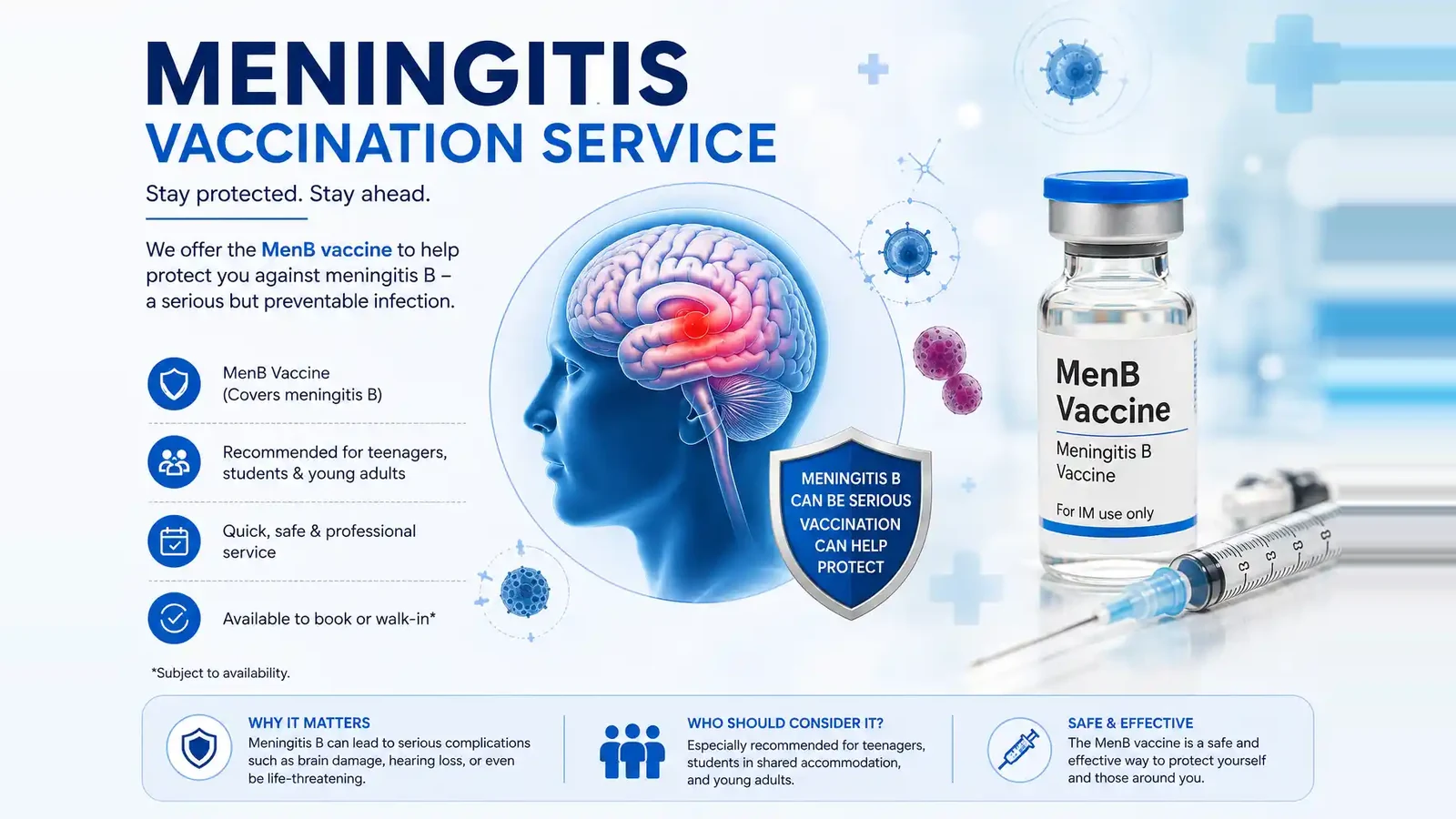
A one-off NHS programme is currently offering the MenB vaccine free of charge to 17 and 18 year olds registered with an English GP, and to anyone under 25 who is starting university or residential further education for the first time this autumn. It is a two-dose course with fixed closing dates, and the student route can be done as a walk-in at a participating pharmacy with no GP registration and no invitation letter. The full eligibility rules, the deadlines and how each route works are set out on our MenB vaccination service page, so please check there rather than guessing.
We are at 160 Pinner Road, Harrow HA1 4JJ, open Monday to Friday from 9am to 6pm and on Saturday from 9am to 1pm, and closed on Sunday. The chemist sits on the road between North Harrow and Harrow town centre, which makes it a straightforward stop for families coming down from Pinner or across from West Harrow, and for students sorting things out before they move into halls. You can reach us on 020 8863 6338 if you would rather ask first.
The honest summary is this. Vaccination substantially lowers the risk and is well worth having, but it is not a guarantee, because the vaccine does not cover every strain of group B and does not touch the other bacteria and viruses that cause meningitis. So do both. Get the doses if the programme covers you, and keep the symptoms in this article somewhere you can find them.
Frequently asked questions
Where our patients travel from
We are at 160 Pinner Road, Harrow HA1 4JJ. Patients come to us for meningitis b symptoms from across north-west London and the surrounding HA postcodes:
- Harrow town centre (HA1) — about a 15-minute walk or a short bus ride from Harrow town centre. Near St Ann's Shopping Centre and St George's Shopping Centre.
- North Harrow (HA1, HA2) — on Pinner Road between North Harrow and Harrow town centre. Near North Harrow station and Pinner Road.
- West Harrow (HA1, HA2) — a few minutes from West Harrow. Near West Harrow station and West Harrow Recreation Ground.
- Pinner (HA5) — straight down Pinner Road from Pinner, roughly a 10-minute drive. Near Pinner station and Pinner High Street.
About the author
Poonam Pankhania — Superintendent Pharmacist & Independent Prescriber
Poonam Pankhania is the Superintendent Pharmacist at Garner Chemist on Pinner Road, Harrow, and an independent prescriber. She leads the pharmacy's NHS Pharmacy First, travel health and ear care services.
More about our teamRelated health advice
What Is Pharmacy First? The 7 Conditions Your Pharmacist Can Treat Without Seeing a GP
Pharmacy First lets your pharmacist assess and treat seven common conditions on the NHS — no GP appointment, no referral, often same day.